
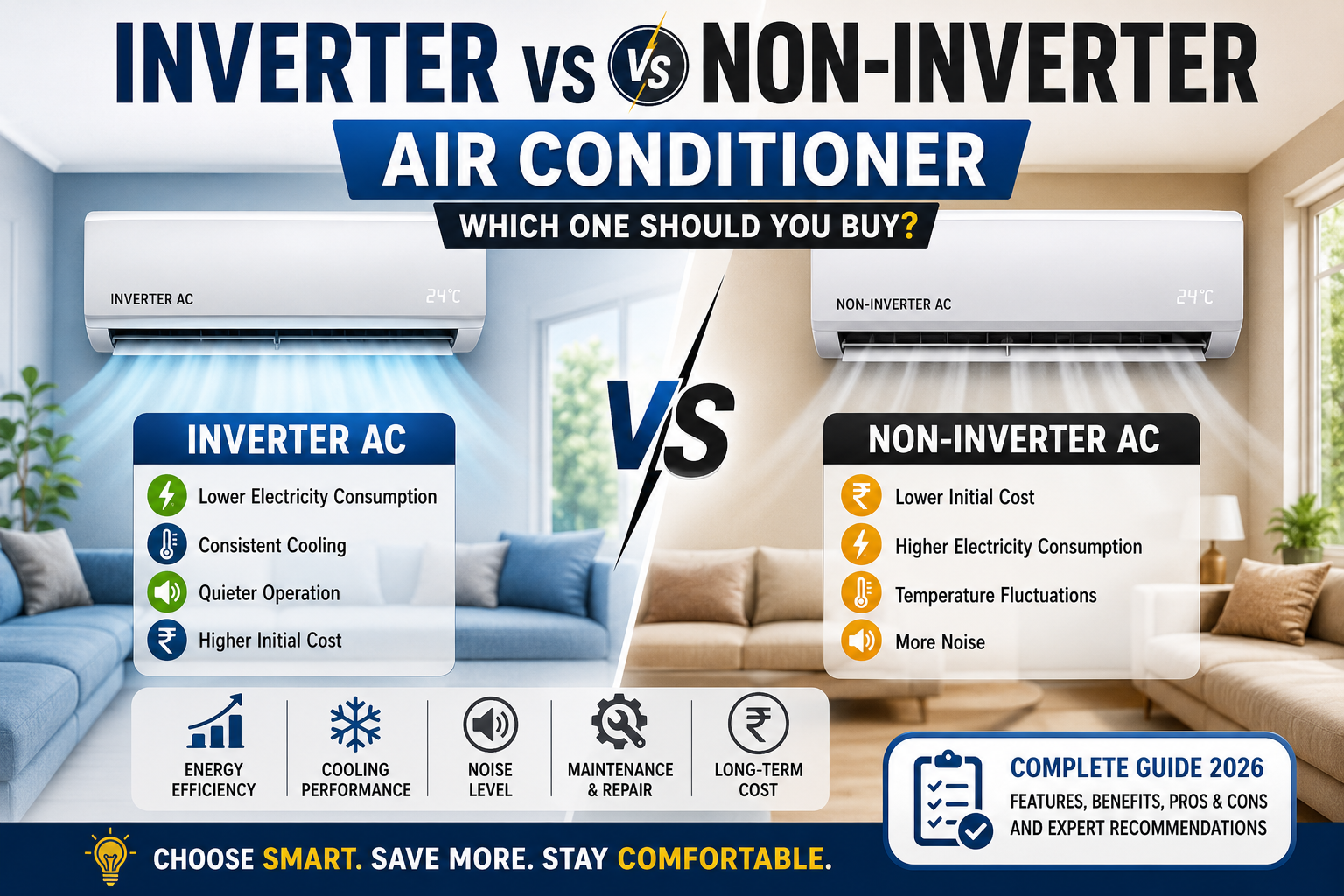
Buying a new air conditioner is no longer as simple as choosing the right brand or cooling capacity. Today, one of the biggest decisions every buyer faces is whether to buy an inverter AC or a non-inverter AC.
If you’ve searched for air conditioners online, you’ve probably noticed that almost every brand offers both options. One model is advertised as energy-efficient and quieter, while another is promoted as a budget-friendly choice. This often leaves buyers wondering if spending extra on an inverter AC is really worth it.
The truth is that both inverter and non-inverter air conditioners have their own advantages. The better choice depends on how often you use your AC, your electricity bills, your budget, and the climate where you live.
In this complete buying guide, you’ll learn the real difference between inverter and non-inverter air conditioners, how each one works, their pros and cons, electricity consumption, maintenance costs, lifespan, and which option offers the best value for your home.
What Is an Inverter Air Conditioner?
An inverter air conditioner uses advanced compressor technology that automatically adjusts its speed according to the room’s cooling requirement.
Instead of repeatedly turning the compressor on and off, an inverter AC keeps it running at different speeds. Once the room reaches the desired temperature, the compressor slows down instead of stopping completely.
This intelligent operation helps maintain a stable room temperature while reducing electricity consumption.
For example, if you set the temperature to 24°C, the inverter compressor initially runs at high speed to cool the room quickly. After reaching the target temperature, it slows down and maintains cooling with minimal power consumption.
This continuous operation is the biggest reason inverter air conditioners are known for better energy efficiency.
What Is a Non-Inverter Air Conditioner?
A non-inverter air conditioner uses a fixed-speed compressor.
Unlike an inverter AC, the compressor in a non-inverter model has only two states—it is either fully ON or completely OFF.
When the room temperature rises above the set level, the compressor starts running at full speed.
Once the desired temperature is reached, the compressor shuts off completely.
As the room becomes warm again, it starts once more.
This continuous ON-OFF cycle repeats throughout the day.
Although this system cools the room effectively, frequent compressor restarts consume more electricity and create noticeable temperature fluctuations.
Understanding the Biggest Difference
Imagine driving a car.
A non-inverter AC is like driving by repeatedly pressing the accelerator fully and then completely releasing it.
An inverter AC is like maintaining a steady speed by adjusting the accelerator smoothly according to traffic conditions.
The second method is naturally more comfortable, quieter, and more fuel-efficient.
Air conditioners work in a very similar way.
Cooling Performance
Many people believe inverter air conditioners cool more slowly than non-inverter models.
This is actually a common misconception.
Modern inverter ACs usually cool rooms just as quickly—and in many cases even faster—because the compressor initially operates at maximum speed before reducing power.
The real difference appears after the room reaches the desired temperature.
An inverter AC continues operating smoothly, maintaining consistent cooling.
A non-inverter AC repeatedly turns OFF and ON, causing small temperature changes that many users can actually feel.
Electricity Consumption
Electricity usage is one of the biggest reasons people choose inverter technology.
Since an inverter compressor doesn’t restart every few minutes, it avoids the high power surge associated with compressor startups.
Over months and years, this results in significant electricity savings, especially for households that use air conditioning every day.
If your AC runs for six to ten hours daily during summer, the lower electricity consumption of an inverter AC can make a noticeable difference in your annual power bills.
However, if you only use an AC occasionally for one or two hours, the savings may not be large enough to justify paying a much higher purchase price.
Noise Levels
Compressor noise is another major difference.
Because a non-inverter compressor repeatedly starts and stops, you’ll often hear the compressor switching on.
Inverter air conditioners operate much more smoothly.
Since the compressor rarely stops completely, the overall operation remains quieter and more comfortable, especially during the night.
If you’re a light sleeper or installing the AC in a bedroom, this quieter performance can be a valuable advantage.
Temperature Stability
Comfort isn’t only about cooling speed.
It’s also about maintaining a consistent room temperature.
With a non-inverter AC, the room becomes cooler while the compressor is running and slightly warmer after it turns off.
This continuous fluctuation may not bother everyone, but some people notice the difference.
An inverter AC continuously adjusts compressor speed to maintain a nearly constant temperature.
As a result, the room feels more comfortable throughout the day.
Initial Purchase Cost
Price is where non-inverter air conditioners still have an advantage.
Since they use simpler compressor technology, they usually cost less than inverter models.
For buyers with a limited budget, a non-inverter AC can still provide reliable cooling.
However, it’s important to think beyond the initial purchase price.
A lower upfront cost may lead to higher electricity bills over the next several years.
Looking only at today’s price instead of long-term running costs is one of the most common mistakes buyers make.
Which One Is Better for Daily Use?
If you use your air conditioner almost every day during summer, an inverter AC is usually the smarter investment.
Lower electricity bills, quieter operation, better comfort, and improved efficiency make it more economical over the long term.
On the other hand, if your AC is only used occasionally in a guest room or holiday home, a non-inverter model may still offer good value because the electricity savings of an inverter unit will take much longer to recover its higher purchase price.
Maintenance and Long-Term Running Cost
When buying an air conditioner, most people focus only on the purchase price. However, the real cost of owning an AC includes electricity bills, maintenance, servicing, and possible repairs over the next several years.
This is where inverter and non-inverter ACs start to show noticeable differences.
An inverter air conditioner generally costs more upfront, but it often helps reduce electricity bills over time. If you use your AC regularly during summer, those monthly savings can gradually offset the higher purchase price.
A non-inverter AC usually has a lower initial cost, making it attractive for buyers on a tight budget. However, because the compressor switches on and off repeatedly, it tends to consume more electricity during frequent use.
If your air conditioner runs every day for several hours, the total cost of ownership is often lower with an inverter AC despite the higher purchase price.
Maintenance Requirements
Both inverter and non-inverter air conditioners require regular maintenance.
Regardless of which model you choose, you should:
- Clean the air filters every two to four weeks.
- Schedule professional servicing at least once a year.
- Keep the outdoor unit free from dust, leaves, and debris.
- Ensure proper airflow around the outdoor condenser.
Ignoring maintenance reduces cooling performance and increases electricity consumption.
Regular servicing not only improves efficiency but also extends the lifespan of the air conditioner.
Lifespan
Many buyers wonder whether inverter air conditioners last longer.
The answer depends more on maintenance than technology.
A properly maintained inverter AC can easily last 10–15 years.
A well-maintained non-inverter AC can also provide many years of reliable service.
The biggest factor is regular cleaning, timely servicing, and correct installation.
Poor installation can reduce the performance of even the most expensive air conditioner.
Repair Costs
Because inverter air conditioners use advanced electronic components and variable-speed compressors, repairs can sometimes be more expensive if major parts fail outside the warranty period.
Non-inverter air conditioners use simpler technology, making repairs easier in many cases.
Fortunately, modern inverter ACs have become much more reliable than earlier generations, and major failures are relatively uncommon when proper maintenance is followed.
Which AC Is Better for Different Users?
For Daily Home Use
If your family uses the air conditioner every day during summer, an inverter AC is usually the better investment.
It provides:
- Lower electricity bills
- Better comfort
- Consistent cooling
- Quieter operation
For Occasional Use
If the AC is installed in a guest room or used only during extremely hot days, a non-inverter AC may be the more economical option.
The lower purchase price often makes more sense when usage is limited.
For Bedrooms
Bedrooms benefit greatly from inverter technology.
Since the compressor runs smoothly instead of switching on and off repeatedly, the room remains quieter and the temperature stays more consistent throughout the night.
For Offices
In offices where air conditioners run throughout the working day, inverter ACs usually recover their higher purchase price through lower electricity bills.
Advantages of an Inverter AC
- Lower electricity consumption
- Faster temperature stabilization
- Consistent cooling
- Quieter operation
- Better comfort
- Environment-friendly performance
- Excellent for daily use
Disadvantages of an Inverter AC
- Higher purchase price
- Repairs may cost more after warranty
- Advanced electronics require qualified technicians
Advantages of a Non-Inverter AC
- Lower initial cost
- Simpler technology
- Easier repairs
- Suitable for occasional use
- Good cooling performance
Disadvantages of a Non-Inverter AC
- Higher electricity consumption
- More compressor noise
- Temperature fluctuations
- Less energy efficient
Quick Comparison
| Feature | Inverter AC | Non-Inverter AC |
|---|---|---|
| Purchase Price | Higher | Lower |
| Electricity Consumption | Lower | Higher |
| Cooling Comfort | Excellent | Good |
| Noise Level | Low | Moderate |
| Compressor Operation | Variable Speed | Fixed Speed |
| Long-Term Savings | Better | Lower |
| Best For | Daily Use | Occasional Use |
Common Myths About Inverter Air Conditioners
Myth 1: Inverter ACs cool more slowly.
False.
Modern inverter ACs often cool rooms just as quickly because the compressor initially operates at maximum power before slowing down.
Myth 2: Inverter ACs don’t save electricity.
False.
They usually save electricity during regular daily use by avoiding repeated compressor startups.
Myth 3: Non-Inverter ACs are outdated.
Not completely.
They’re still a practical choice for buyers with limited usage and smaller budgets.
Buying Tips Before You Decide
Before purchasing any air conditioner, ask yourself these questions:
- How many hours will I use the AC each day?
- What is my monthly electricity budget?
- Is this AC for a bedroom, living room, or office?
- How long do I plan to keep this air conditioner?
- Is energy efficiency important to me?
Answering these questions honestly will make your decision much easier.
Frequently Asked Questions
Which AC is better for home use?
For most homes, an inverter air conditioner is the better choice because it offers better energy efficiency, quieter operation, and more consistent cooling. If your family uses the AC regularly during summer, the long-term electricity savings can outweigh the higher purchase price.
However, if you only need an AC for occasional use, a non-inverter model can still be a practical and cost-effective option.
Does an inverter AC really save electricity?
Yes, but the amount of savings depends on how often you use it.
An inverter AC adjusts the compressor speed instead of switching it on and off repeatedly. This reduces unnecessary power consumption and helps lower electricity bills during regular use.
If the AC is used for only one or two hours occasionally, the difference in electricity cost may be relatively small.
Is a non-inverter AC a bad choice?
Not at all.
A non-inverter AC still provides effective cooling and remains a good option for buyers who have a limited budget or use air conditioning only occasionally.
The main drawback is higher electricity consumption during extended daily use.
Which AC cools faster?
Both inverter and non-inverter air conditioners can cool a room quickly when they are correctly sized for the space.
The major difference isn’t cooling speed but how the compressor operates after reaching the desired temperature.
An inverter AC maintains cooling more smoothly, while a non-inverter AC repeatedly turns the compressor on and off.
Which AC requires less maintenance?
The maintenance routine is almost the same for both.
Regardless of the model you choose, you should:
- Clean the air filters regularly.
- Schedule annual servicing.
- Keep the outdoor unit clean.
- Ensure proper airflow.
Good maintenance is far more important than the type of compressor.
Which AC is quieter?
An inverter AC is generally quieter because the compressor continues running at a lower speed instead of stopping and restarting repeatedly.
This makes it an excellent choice for bedrooms, study rooms, and home offices.
Which AC lasts longer?
Both inverter and non-inverter air conditioners can last for more than ten years when properly installed and maintained.
Regular servicing, correct installation, and timely cleaning have a much bigger impact on lifespan than compressor type.
Expert Recommendation
After comparing both technologies, it’s clear that neither option is perfect for everyone.
Your choice should depend on your usage, budget, and long-term expectations.
Choose an Inverter AC if:
- You use the AC every day.
- Lower electricity bills are important.
- You want quieter operation.
- You prefer stable room temperature.
- You’re planning to use the AC for many years.
Choose a Non-Inverter AC if:
- You have a limited budget.
- The AC will be used only occasionally.
- You’re installing it in a guest room or holiday home.
- Lower upfront cost is your priority.
Final Verdict
Choosing between an inverter and a non-inverter air conditioner isn’t about selecting the newest technology—it’s about selecting the right technology for your lifestyle.
If you run your air conditioner for several hours every day, an inverter AC is usually the smarter long-term investment. Although it costs more initially, it offers lower electricity consumption, quieter performance, better temperature control, and improved overall comfort.
On the other hand, if your air conditioner is only used occasionally, a non-inverter AC can still be a sensible option. Its lower purchase price makes it attractive for buyers who don’t expect heavy daily usage.
Before making your final decision, think beyond the price tag. Consider how often you’ll use the AC, the size of the room, your monthly electricity budget, and how long you plan to keep the appliance.
The best air conditioner isn’t simply the one with the most features or the highest price. It’s the one that fits your home, your usage, and your budget.
Making an informed decision today can help you enjoy comfortable cooling while saving money for years to come.
Quick Buying Checklist
Before purchasing an air conditioner, keep these points in mind:
- ✔ Choose the correct AC capacity for your room size.
- ✔ Buy from a trusted brand with reliable after-sales service.
- ✔ Compare the annual energy rating.
- ✔ Check the warranty on the compressor.
- ✔ Consider long-term electricity costs, not just the purchase price.
- ✔ Schedule regular servicing to maintain cooling performance.
- ✔ Read verified customer reviews before buying.
- ✔ Compare installation charges and maintenance costs.
- ✔ Select the model that matches your daily usage rather than simply choosing the cheapest option.
By following this checklist, you’ll be able to choose an air conditioner that provides reliable cooling, better comfort, and excellent value for your investment.
Leave a Reply